
by Alex Wells
Critics often pay lip service to the idea that capitalism can distort a work of art but Los Angeles-based installation artist and photographer Maggie West provides an unusually concise and reflexive case-in-point. Coming on like a slow case of Blade Runner virus. West’s work is increasingly apparent on sides of buildings, in corporate lobbies, at music festivals in Southern California and beyond—you likely have seen it without knowing it. West is an artist of genuine vision whose work constantly risks having the potentialities that vision enables undercut by the firehose of money required to manifest it.
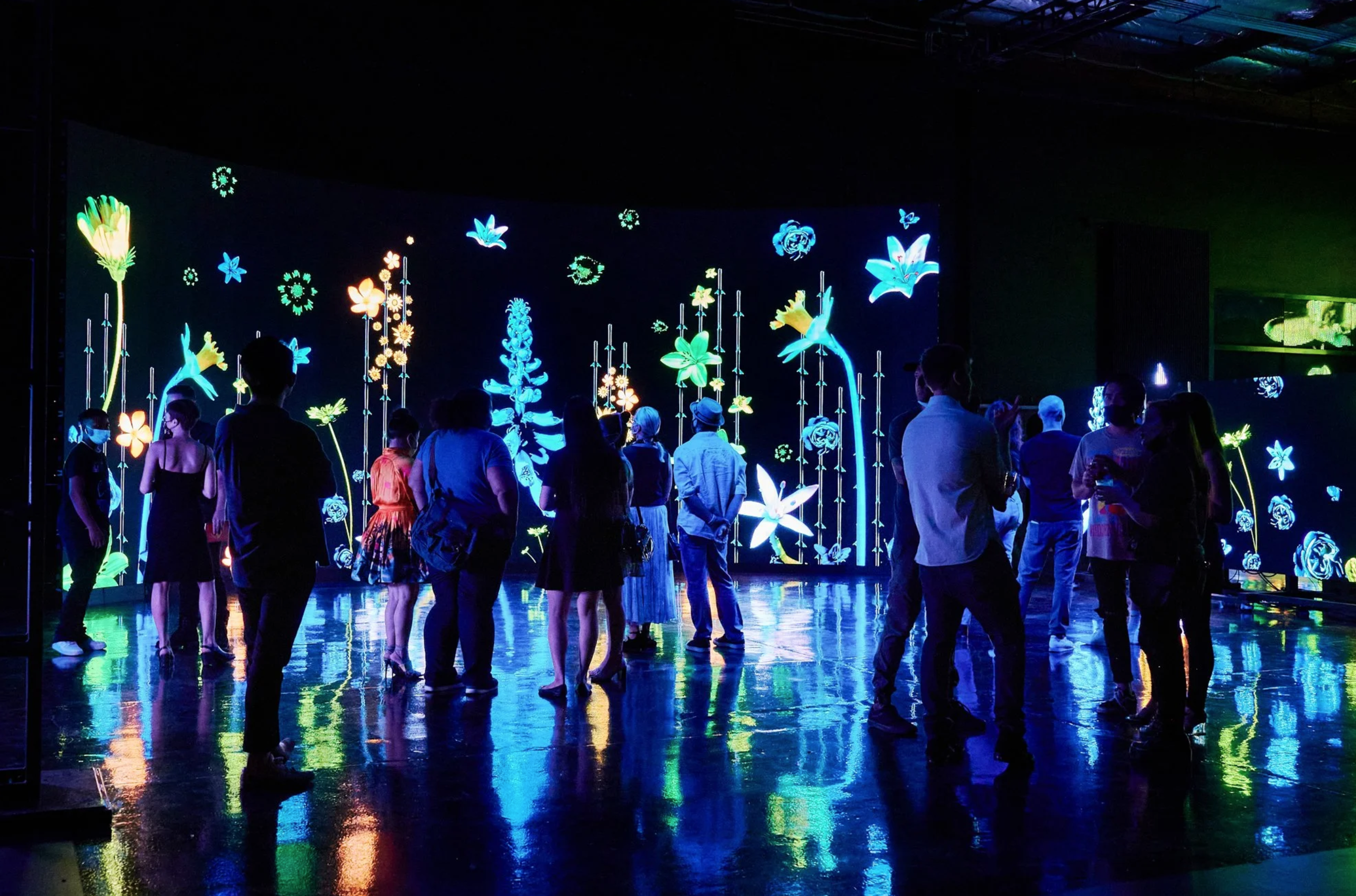
West is one of those feast-or-famine artists who produces nothing unless it can be expressed in the form of an immersive installation. Perhaps most well-known for her photo-installation Eden at Coachella 2023, she lives and dies by the grants and partnerships required to create and even simply display the pieces. With an entire wing of her home sequestered off and devoted to high-tech cameras automatically photographing flowers for months and even years on end, West simply could not exist in her current incarnation without tech institutions and innovations. This doesn’t make her boring: while her subject is classically commercial and crowd-pleasing, West’s choices have an eerily science-fictional—almost horror-film—edge, bringing a safe-cracker’s eye for disturbance and detail to her blacklit tableaux. The massive scale her patrons’ money provides is not mere extravagance: magnified dozens of time, the botanical eccentricity and alien biology of plants makes these images far more than simply a retread of cottagecore aesthetics. Likewise West’s druggy club-girl palette is disconcerting when paired with subject matter that is so undeniably real, familiar, and solidly framed. West’s work at its best imbues the viewer with a renewed sense of biofascination at the weird and easily-dismissed life that seethes in every garden.
The problem, really, is everything else: like a fine Romantic portrait dwarfed by a tasteless Baroque frame, West’s work inevitably comes packaged with a massive dose of seen-it-before in the form of psychedelic pattern and Vegas-style presentation. Consciously or otherwise, the power of the institutions that make these installations possible repeatedly insists on foregrounding itself in forms that make West’s work less about itself than about the ability to control enough light and space to show it to you. West’s installations feel less like art pieces in themselves than the kind of cheesy “immersive experiences” designed to make uncurious and fundamentally art-immune audiences care about Kilmt or Van Gogh.
As there is finally nothing to be “immersed” in here except images, the work becomes neither fish nor fowl: too distractingly amplified and self-contextualized as decoration to easily be viewed as objects of artistic contemplation, but lacking the total commitment to architectural or experiential design that would be required to make them something else. Quite simply: there is nothing to do in West’s installations but look at them—no tunnels to crawl or controllers to wiggle or swimming pools to float past them in—and everything about them suggests that mere looking is somehow not enough. Just as one could imagine a less tech-obsessed West simply giving us modest lightboxed loops of her dazzlingly filmed phenomena one could also imagine West contributing satisfyingly to the creation of an unforgettable nightclub or Disney-style thrill ride, but—as it stands—she seems to have shackled her considerable talent to a form which suppresses the art’s ability to makes us wonder about the natural world or our alienated experience of it and instead repeatedly begs the question “How much do you think this costs?”
Image: Courtesy Maggie West.