
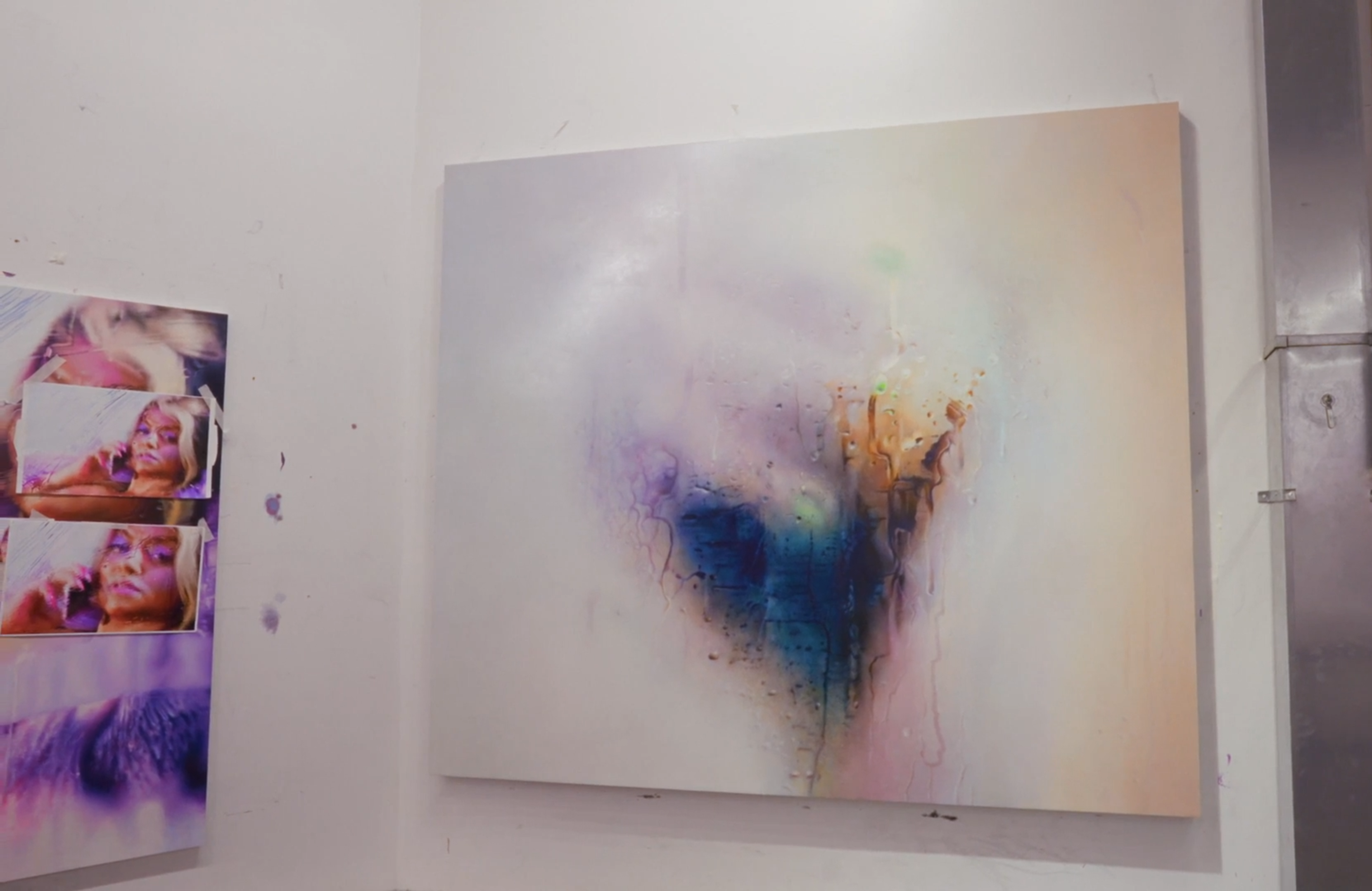
Marilyn Minter is now painting portraits—Lizzo, Jane Fonda, Monica Lewinsky, a host of fellow art stars. If a man was making her wet, glossy, deliriously pervy work, you’d suspect her of painting people she wanted to fuck—as presented in Pretty Dirty: The Life And Times of Marilyn Minter, however, it seems more like Minter’s painting those she wants to co-opt.
Although it certainly will fill any Minter fan in on all kinds of things they want to know, this is the kind of docu-tisement that gives you footage of Jeff Koons—final boss of late-century PoMo irony and Minter painting subject—saying ”Marilyn’s work changes how we perceive ourselves, what we can be, what we can become,” and expects the audience to take it as both meaningful and a meaningful endorsement. It is teasingly symptomatic of the entire project: there’s a lot to unpack here, but all the zippers are welded shut.
Just as Koons’ appearance is meant to assure art world viewers of Minter’s blue-chip reliability, the much younger, blacker, queerer and equally glam-obsessed artist Mickalene Thomas appears to attest to Minter’s relevance: “I tell many young artists about her practice.” This might’ve packed a less equivocal punch if Thomas hadn’t been canceled by her own girlfriend for alleged sexual wrongdoing between the time the film was made and the time it came out, but reality is messy that way.
No-one brought that up during the Q&A after the press screening last week at LA’s Soho House (West Hollywood), where Minter, the filmmakers, and a blue pant-suited Jane Fonda fielded softball questions from the crowd along with two “More a comment than a question”s—one from a woman who simply gushed about how inspiring the work was, another from a man with several minutes worth of lore and opinion about pubic hair—a perennial Minter subject.
While Minter’s actual paintings are the worst kind of fuzzed-out, assistant-blunted, billboard-painter good-from-far-far-from-good photorealism, as a photographer, videographer and image-maker she is undeniably talented, influential and controversial. One of the most interesting things about Minter’s close-up and moistened views of interrupted glamour is how many feminist artists love it and how many feminist critics hate it.
One of the few visual nods to the latter appears in the film in the form of archival footage of anti-sex radfem Andrea Dworkin, literally waving her arms, almost literally spitting fire, saying “If you want to continue to believe that this is a matter for debate instead of an emergency…[trails off into presumably something mean]” which sums up the attitude on both sides. There are no debates here, only two sides—one side including celebrities, museum directors and young female artists who paint tits, the other anonymously holding signs saying things like “Porn is the art of the male death culture” just before a cut to Jesse Helms angrily waving around a picture of a vagina on the floor of the senate.
Minter’s story is presented as involving three struggles: against her family’s lack of support (her playboy father gone and her mother permanently and vocally pissed off at Minter’s total failure to become a proper southern debutante), against drug addiction (presented frankly but, alas, entirely devoid of gritty details or amusing anecdotes), and against anti-porn feminism. The last struggle is the only one clearly visible in the work, although the Minter-influenced marketing of HBO’s Euphoria’s certainly emphasizes a connection between Minter’s ecstatic imagery and party-girl past.
Minter’s struggle against the forces of art-critical puritanism is presented simply: First, she began to explore sexualized images, second, her career tanked, “Then,” in Minter’s own words “the internet happened and my side won.” The closest thing to any in-depth discussion of the issues involved comes from Brooklyn Museum’s Anne Pasternak, who says of Minter’s first porn-inspired show in the 1990s “I was so disturbed by it, I also went back a bunch of times. Maybe I was also a little titillated when I think about it now!” Apparently she hadn’t thought anything more in-between. It’s too bad—the internal journey of a powerful art world gatekeeper who goes from having one stock response to Minter’s work to the polar opposite stock response might have illuminated something—especially when one considers this is the same museum director who green-lit Hannah Gadsby’s sex-shamey “It’s Pablo-matic” exhibition two years ago.
Hints of the same kinds of kinks and complexities reappear throughout: the idea that Minter’s signal and powerful transgression is producing pornographic imagery while being a woman is promulgated throughout the film—contrasted with the “male gaze” and the instant acceptance granted Minter’s contemporary Koons after his first pornified show. Yet Koons—veteran of a messy divorce from his own porn-star wife—is described as a hero by Minter, just as Minter herself is described in the film as a hero by rising star Jenna Gribbon, who then goes on to say “I want to portray the experience of romantic involvement with a woman from the perspective of a woman in showing sexual desire, for example. But its tricky to do that and not fall into the trap of this sort of like mirroring the male gaze just because that has been abused in the hands of male artists…”.
Also, by the way, its clear many of Minter’s paintings are painted mostly by a man—long-time studio assistant Johan Olander. What does all this mean? If the image itself is the locus of supposed pleasure or danger, does it matter whose gaze produced it? Why? How did we get here? Is there a way out? Should there be? Pretty Dirty points at all of this and discusses none of it. Its ultimate value is as a datapoint in a discussion that, at this rate, will never end.
Image: Courtesy Jennifer Ash Rudick and Amanda M. Benchley