
by Sam Schultz
I have this theory: that money buys bad ideas.
Stay with me here.
Most critics, myself included, have a somewhat jaded view of art that’s made—and when I say “art,” I mean almost all art made from the beginning of time up until the present day—is bad. Not that people shouldn’t make art, they should do whatever the hell they want, but most of the time the art that they make is not worth looking at.
If we start with the premise that most art is bad, than the very few artists (past, present and future) that have access to monetary means also have the ability and often the resources to make sure that their bad art is at least seen (and therefore perhaps purchased) rather than being lost and ignored among the vast amounts of bad artwork being created. But just because we can see it, does it mean we should?
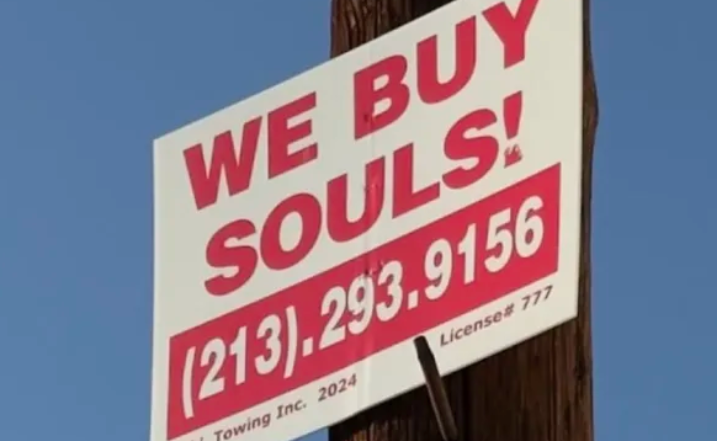
Enter “WE BUY SOULS,” the solo exhibition by RABI (David Emanuel Mordechai Torres) which opened last weekend at Good Mother Gallery. Torres, a street/graffiti/global-muralist/art darling, brings together his years-long public intervention project where he placed signs around the city which read “WE BUY SOULS” in a variety of languages (a play on the common cut-rate house-flipping sign “WE BUY HOUSES”) offering a phone number for people to call and offer their souls up for purchase.
Did people call? Yes, it seems many did.
Upon entering the gallery you are faced with an epilogue of sorts explaining the project (printed on a large scroll of paper that hangs from the ceiling spilling onto the floor). On it, it explains that an LLC was formed as a “corporate acquisition firm” with which to actually purchase people’s souls, thereby mixing public art, performance art, and economic depression into a capitalist corporate “play” on art, religion, and, oftentimes financial desperation.
Next to the scroll is a giant hyper-realistic painting of a candy red, push-button telephone which matches red telephones sat on top of stacks of printed paper contracts laying out the terms of the purchase.
Printed text from several of the messages are hung on the gallery walls along with a monitor playing a video with an AI generated woman verbalizing the terms of the agreement.
Several hyper-real life-sized sex dolls also make an appearance. A large-breasted female kneels on the ground propping up an oversized sculpture of a cross covered in digitized screens scrolling the words “WE BUY SOULS.” A male doll lies on a business desk curled up in a fetal position while clutching a computer monitor.
Torres acknowledges the idea is not original and was in fact inspired by a project in the 1980s by Komar & Melamid titled “We Buy and Sell Souls” where a company was formed and people were encouraged to buy American souls which would later be auctioned off in New York and Moscow. Even plutocrat-artist OG Andy Warhol signed his soul over to them.
So…someone else’s idea from the 1980s, now with AI, sex dolls, and a multi-lingual component.
As a social experiment—it’s almost interesting. It is more than a little sad in that one has the feeling that desperate people really did call willing to trade whatever they believed they had for money. But then you have to ask why do it? Well, because Torres has the financial means to—which circles us back to my first sentence.
You don’t have to have spent too much time reading Marx to realize that Torres is doing this—and attempting to profit from it—because he can afford to, and that desperate people will participate because they don’t. And they don’t because he does. You know all that without even going to the show.
Which is most likely why the sex dolls are there.
Image: Courtesy Good Mother Gallery