
by Anika Bukon
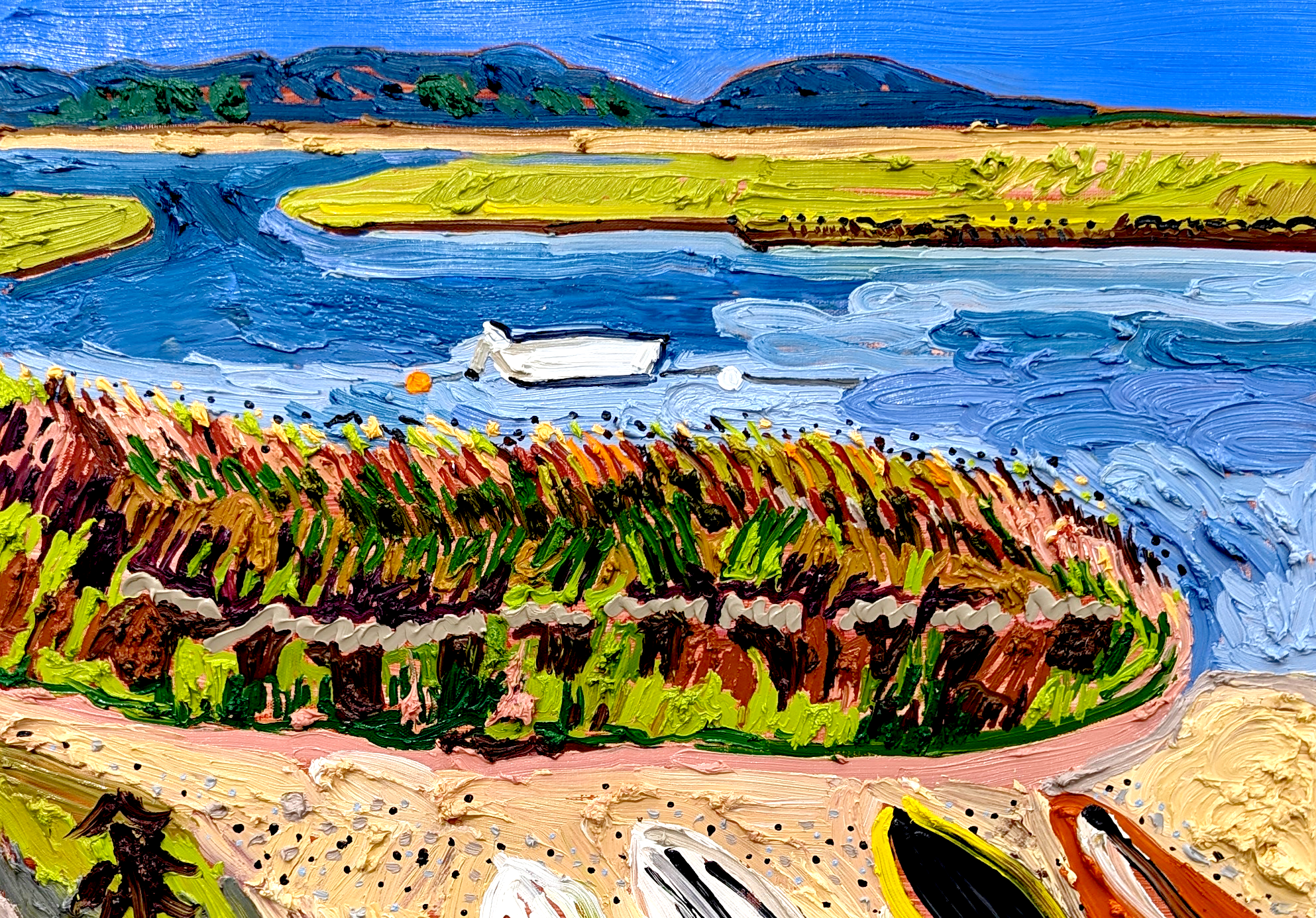
I will always love the smell of freshly-painted not-yet-dry oil paintings and I have a theory that Night Gallery reserves their small back room exclusively for just such shows. Currently that space contains oil paintings by Susan Chen, hung in an exhibition called “Old Cape Cod.”
The title of the show is remarkably on point: thickly impastoed images of fields and flowers and water and boats, looking exactly like the kinds of paintings my grandmother makes. My grandmother takes a painting class in her local retirement community and often tries to render photographs from her local travel magazine in paint. She does this the way Gerhard Richter supposedly did, without any attempt at personal choice, instead electing to try and copy as accurately as possible the photo in front of her.
Being merely my grandmother, she cannot do it, however, and instead the paintings end up looking like rudimentary attempts at painting 101–but I like them, even love them, because my grandmother made them earnestly and without ego or without a pre-conceived idea or attempt to sell them, but purely because she wants to paint even if she doesn’t have a single original idea about paint or painting.
Chen’s paintings look like this.
They’re earnest and uninspired. Colorful and thick with mounds of oil, but unambitious—unless the ambition is to have the winsomely common labor of all Sunday painters recognized as cutting-edge art. They are sweet, but predictable and boring beyond my ability to explain. If Chen were my grandmother I’d probably put up one of her paintings in the laundry room, but she is not, so I have no emotional or social obligation to like them or have them take up space on my wall.
Chen is in her mid-30s and received her MFA from Columbia and a BA from Brown. Like many young female painters, that education suggests some shadowy justification born out of the 1970s Pattern and Decoration movement which used feminist rhetoric to reframe floral patterns and conventional prettification as vital Women’s Work in need of rediscovery and defense against a patriarchal order which defined it as unworthy. The problem, in Chen’s case, is that any defense of her own work would require defining women’s work as a brand of kitsch work requiring neither skill nor personality.
According to the show’s press release, the paintings were inspired by Chen’s own visits (spanning over a decade) to seaside Cape Cod and places her work “among Helen Frankenthaler, Lee Krasner, Edward Hopper, and Andrew Wyeth”—three artists whose ambition was to do something visually new with their materials.
In a world perverse enough to have produced an entire grannycore subculture, where able-bodied young people Tik Tok themselves dressing up in knit and crocheted oversized flower-print shawls, it would be shocking if there weren’t a fine art equivalent. But Chen hasn’t yet given us a reason to look at it.
There is a realness to grannycore, to grandma’s paintings, and anything else that has an air of gray frump around it—it is an aesthetic of comfort and desexualization earned through years of putting up with everyone else’s bullshit. It is the aesthetic of she who is tired and no longers gives fucks. The authenticity of this gesture of rejection, however, lies in its lack of ambition. The coolness of grandma trundling around her palace of nostalgia, flora, thick fabric and reassurance is the coolness of someone refusing to be on display.
Whether or not Chen, at 34, has earned this energy is her business, ours is that she has not yet devised any compelling reason to transport it from the attic to the showroom.
Image: Courtesy of Night Gallery