
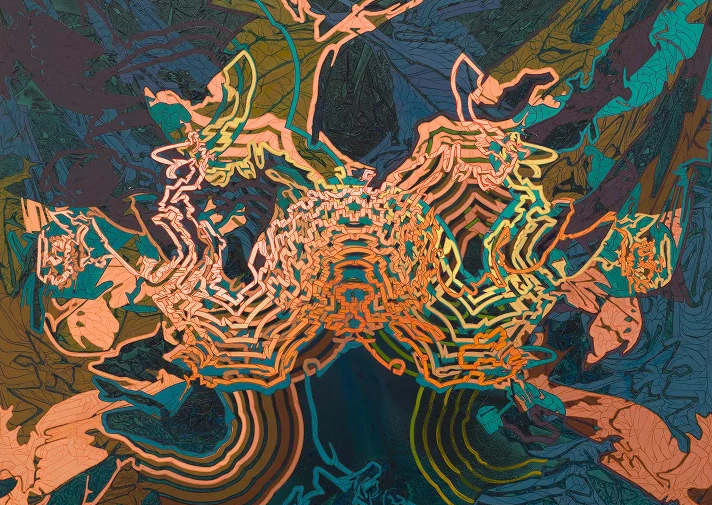
“In Plane Sight,” Face Guts’ requisite summer group show was assembled by guest curator and artist Alvaro Ilizarbe. It features seven works on the smaller side from 6 different artists in a small jewel-box storefront located next door to “Home Guts”, Biskup’s more home-decor leaning storefront.
In his own work, Ilizarbe leans heavily on grid patterns, hard diagonals, and hyper-stylized block shapes and letters. The art on display here offers a much softer, squishier version of the concept of pattern. According to the press release, Ilizarbe’s intent was to “gather the work of women artists whose practices engage with hidden architectures in reality.”
What actually emerges is a show which is interesting in terms of the specific kind of uninteresting that it is. On top of the familiar question raised by any show of more-or-less cheerful abstraction next door to “Home Guts”—”Is this just home decor?”—a novel new question here emerges: did a person even make this?
And, perhaps more intriguingly, was the banal face of the average 21st-century fine-art object ever worth looking on in the first place?
Candace Thatcher’s Archive Scan XLIV, 2012 and Archive Scan XLVII, 2025, two works showing a glitched/moiré patterned grid–one in red, purple, and green and the second in blue, purple, and green—created using Thatcher’s signature process of glitching and manipulating pixels, data and algorithms and then printing the resulting low-resolution images onto panel–live quite nicely next to Kristin Posehn’s Ada’s Net, 2025—another gridded work with enlarged lace patterning–but all three could also comfortably live on the front of a middle-school math textbook. See kids? Math can be momentarily diverting! Anyway, let’s turn to page 257 and talk about PEMDAS.
Linnèa Gabriella Spransy’s Slow Benthic Pulse, 2025 an abstract but hyper-illustratively crisp yet edgeless earth-tone-damaged mini-mural of squiggly pink ribbons atop a teal, blue and purple background looks like a closeup of electrical systems gone haywire, the inside of Aunt Bertha’s knitting basket, or something the Department of Transportation might hire you to paint on the side of a train station to make navigating an urban subway system look homey and unthreatening. It would be easy to imagine Spransy typing “abstract painting suggesting a middle-aged woman who lives alone with plants and does not like going out other than to hike” into Midjourney and it spit this out if it wasn’t for the fact she’s been painting like this for years. Sedona Cohen’s Templo del Agua que Guarda Lu y Memorias has no date marked, which raises a fitting question: if this upside-down-diamond-shaped polystyrene wall piece painted in blues with a surface CNC-carved ethereal surface of curved windows and perspective lines didn’t have superficially modernizing cybertouches would we consider it the work of an unambitious and less-gifted follower of the midcentury Dynaton movement currently showcased across town at Château Shatto?
Speaking of midcentury-modern, Ekta Aggerwal’s Pieces of the Past: I (2023), consisting of “fun” colored rectangles in reds, yellows, and near-black with circular holes punched out and sewn lifelessly and at geometricized-random onto a substrate looks markedly out-of-place because it’s so bright, but markedly in-place inasmuch as it sucks and is dull and looks like literally the artist had one idea about displaying one kind of shape in one kind of color and hit “execute.”
Likewise out-of-place is Brooke Schuh’s Receiver, 2026, a ceramic sculpture that is one part tree of life, one part mutating pelvis and one part Medusa-head covered in a creamy glaze with stripes of gold lustre. It’s creepy, it’s curly, it’s drippy, and it’s the only thing that doesn’t send you scurrying toward your Turing Test to check if a human was involved. In any other show it would look like a promising start, here it feels like a breath of fresh air.
Image: Courtesy Face Guts.