
by Anne Gabriel
At the expense of the Weekly Footnote turning into an obituary rag of famed artists most recently deceased, I felt I needed to add a note about Faith Ringgold, an African-American artist known for her naive-style quilts painted with a quirky mix of urban stories, political activism, and surrealism, and yeah, she just died too.
Ringgold grew up in urban New York as part of a solidly working class family in Harlem during the middle of the Harlem Renaissance, went to University and got a degree (almost unheard of during the 1950s for a black female) and then taught art during the Civil Rights Era and beyond. She was a young, educated, black, female, intellectual smack dab in the middle of one of the largest cities during THE largest turning points of the black experience in Twentieth Century America —who made art—but in a decidedly safe way and maybe that’s because she was trying to stay alive by doing so. Was she a subversive radical?
When I look at Ringgold’s works from the 1960s, which were arguably made during the height of the Civil Rights Movement, what I see is the utilization of popular 60s graphic conventions of large color swaths with hard outlines and hard shadows, used to advance images from an extremely heated social climate and presented in a fairly bland kind of way. Sure, white people and brown people are painted together on a canvas. They are looking at each other blankly or staring forward at the viewer, blankly. However the canvases are not requiring anything from you. They are not created to make you uncomfortable, in fact they feel quite the opposite, like they were created to look familiar, to lull you into a safe space where you can be made to look at the graphic image staring back at you. Nothing jarring to see here while the images are entering your psyche through graphic subversion.
During the later part of the 1960s and 1970s, Ringgold produced work that seemed to have blatant opinions associated with it. Maybe her high school students influenced her, maybe she got tired of seeing people beaten in the streets —either way her work became more aggressively active in supporting and highlighting more assertive organizations and movements including the Black Panthers, prison uprisings, and the Women’s Liberation Movement. The work again, wasn’t anything new, novel, or groundbreaking, in fact much of it looked like protest posters, but Ringgold used her work to support those affecting change, again utilizing easily digestible graphic tendencies.
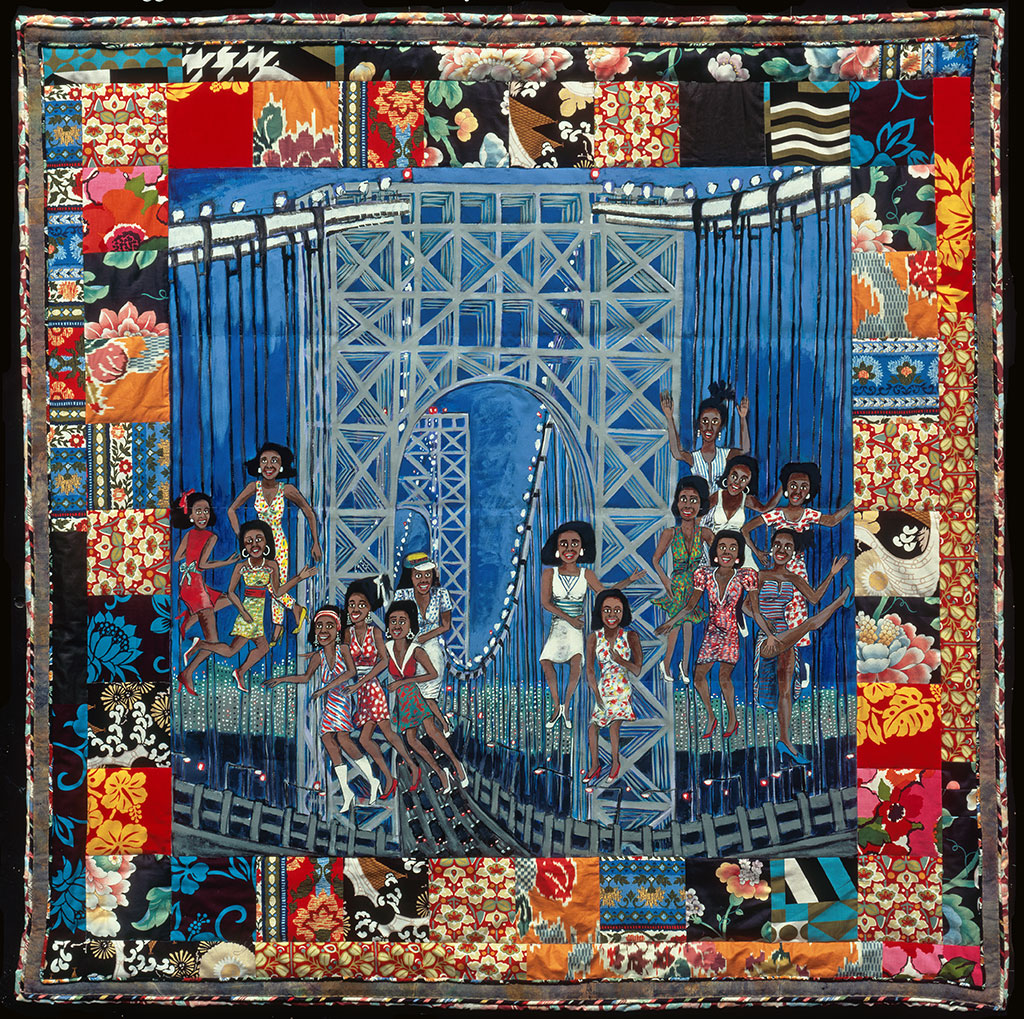
During the 1980s Ringgold created some of her most famous works—the story quilts. As with her more graphic leaning works, quilts-as-craft became a safe vehicle for viewing and consuming the black experience. They’re soft “blankets” after all, nothing dangerous. Many of the story quilts, with the exception of the very political Who’s Afraid Of Aunt Jemima, are painted images of an urban black experience centered on marriage, love, and domesticity with paintings that were cloyingly sweet, and full of flowers and details. They read like love letters and personal reflections of a life lived and possibly lost. Again, nothing uncomfortable here with her choice to normalize and present for consumption personal experiences of being black in America, and elevating those experiences into fine art mixed with craft so a younger generation can at least see that it’s possible.
Her final two working decades, the 1990s and the 2000s, see Ringgold continue her story quilts, but returning to a focus on more historical and political themes and questioning art historical cannon. As an educator, she still may have been trying to use her platform to influence and teach the next generation of activists, this is clearly seen in her series Coming to Jones Road Under A Blood Red Moon, a series about a runaway slave family traveling North that was turned into a children’s book, again another fairly safe vehicle for story consumption.
In all, Ringgold was a prolific artist with a career that spanned decades. She was centrally positioned during the height of the Twentieth Century Black experience to make art and influence countless young minds in her classrooms. But what her work lacked in blatant radicalism, it more than made up for in subversive activism using tools that allowed them to feel safe while lulling and disarming the viewer into consuming the American black experience.
Image: Faith Ringgold, Dancing on the George Washington Bridge