
In civilian life, I am prone to exaggeration. I often have to check myself. My first reaction to seeing the new LACMA building was that it looked like a prison. A friend rolled her eyes, asked if I’d ever been to a prison. I mention this to say where I started.
Everyone in the city will have an opinion about LACMA’s new Peter Zumthor-designed and Michael-Govan-conceived David Geffen Gallery, an ice-cream sandwich of concrete and glass presiding over Wilshire Blvd and the Tar Pits with amoeba-like skirt-roofs undulating in mid-air. Money says that opinions will be mixed but that most Angelenos, and the news outlets that cater to them, will accept the building as is, because, well…it isn’t going anywhere during their lifetimes and is undeniably more interesting than nothing and/or another parking lot.
During last week’s press conference, a young woman stood before a crowd of amassed reporters and went much further, proclaiming Govan as a culture revolutionary and that his singular vision for LACMA has placed him among history’s famed culture creators. Then Govan stood up and delivered his pleasantries and thank yous and reminded the gathered press of *his* vision for a non-hierarchical museum, one in which “everyone is in the front and no one is in the back.”
And, to be honest, he had a point.
Many of the works, hung on long concrete hallway corridors or sat upon movable tables and glass cases live up to that promise, and frankly read much like a Tiffany showroom—and why not? Give the people what they’ve all seen on the way here if nothing else—a showroom, fronted in glass and dripping in cachet.
LACMA’s stated intent is to combine contemporary art with older and ancient works in a space where, it is claimed, the collection will be constantly rotating.
LACMA has divided its space (and collection) into four main bodies of water—the Pacific, Atlantic, and Indian oceans, plus the Mediterranean Sea—but otherwise claims it will pursue a new approach that it claims will de-center and de-prioritize art history in lieu of showing the public “connections” between various art styles that span time periods.
Govan thinks you should wander around the space “discovering” art and connections rather than have the museum attempt to teach the trajectory of art history. For that, the museum staff says, is easily Googl-able. The approach is novel and prioritizes connection between different art forms in a way the public may not readily be seeing. This sounds boring mainly because its true.
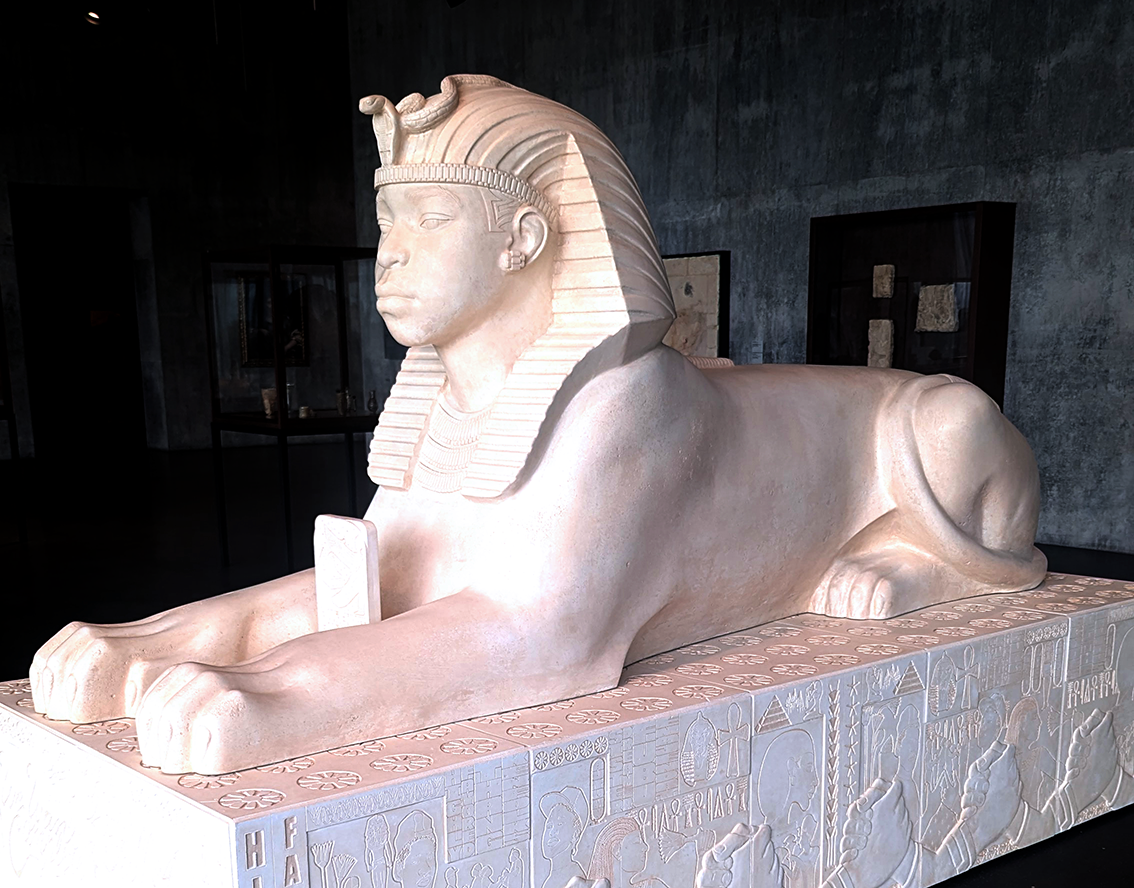
An example of this curatorial strategy can most easily be seen where LACMA commissioned artist Lauren Halsey (born 1987 in our fair city) to create a 10 foot long Egyptian sphinx shown alongside ancient wall reliefs, mosaics and sculpture from unnamed Egyptian and Roman artists from the 1st and 3rd centuries.
Do I like it? I do! With attention spans and tastes changing in a hyper-image-changing-and-flooding cultural landscape, we probably should revolutionize what a museum is. It can be both a repository of works and a spur to discuss connections among those works. Consider me a convert, LACMA.
Image: Staff