
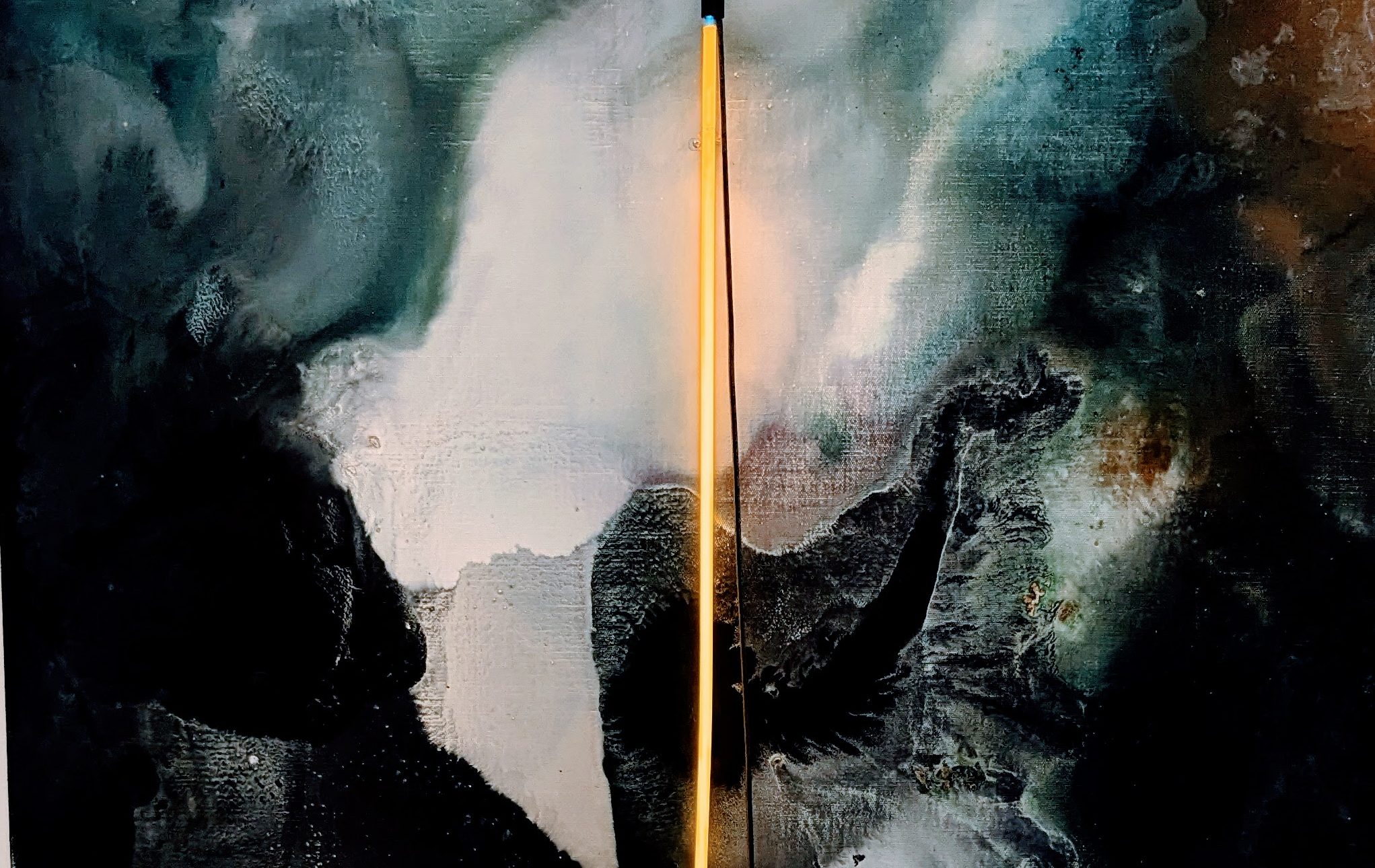
by Anne Gabriel
It’s been a while since I’d been to the Kordansky campus, so I decided to take a jaunt one fine afternoon to view the Mary Weatherford show. Weatherford is a local LA artist with an expansive studio (and team of studio assistants) in the local suburb of Glendale—I know because I went to a party there once.
Weatherford is known for making large expansive abstract canvases and then placing a tube of neon across them. If it sounds very 1980s, that’s because it is.
Weatherford’s latest exhibition at Kordanksy provides more of the same—large expanses of canvases with blobs on them—I call them splotches but got into a semantics argument when a fellow artist who suggested they weren’t blobs at all because they seemed to have some semblance of form that the artist was attempting to convey. I call them blobs none the less, because they are non-representational and look like giant pools of paint that have been poured on the canvas and then possibly wiped off? Although there are clearly multiple layers and some attempt at illusionism, the canvases read like process paintings where the “act of painting” is what is on display rather than any subject matter or content suggested within them. In fact, if they were just process paintings I might like them a bit more because they would then seem intentional, rather than fall across the line into gimmickry once Weatherford places her tube of neon across them.
Kordansky’s website lauds Weatherford as one of the leading painters of her generation, as well as one of the most astute and daring practitioners of abstraction.
What is daring about repeating a single painting over and over again for decades in different colors? That she adds a neon tube? Oh, she repeats that as well, over and over again.
Weatherford has no lack of technical ability. Her skill is evident in her color play and canvas compositions, she’s just boring and no amount of neon can save that, no matter how large the canvas.
There was a new direction being shown at Kordansky—large abstract blobby canvases—with a small piece of something, an object offset from the canvas itself, placed right in the middle—making it feel like a crumb at the corner of someone’s mouth that shouldn’t be there where you have to fight the inclination to just rub it off, but then it stays too long and both you and the eater are embarrassed once they become aware of it.
Come to think of it, all of her paintings feel like that.
Photo: Staff