
by Anne Gabriel
I can confirm that I think gallerists are on a lot of drugs.
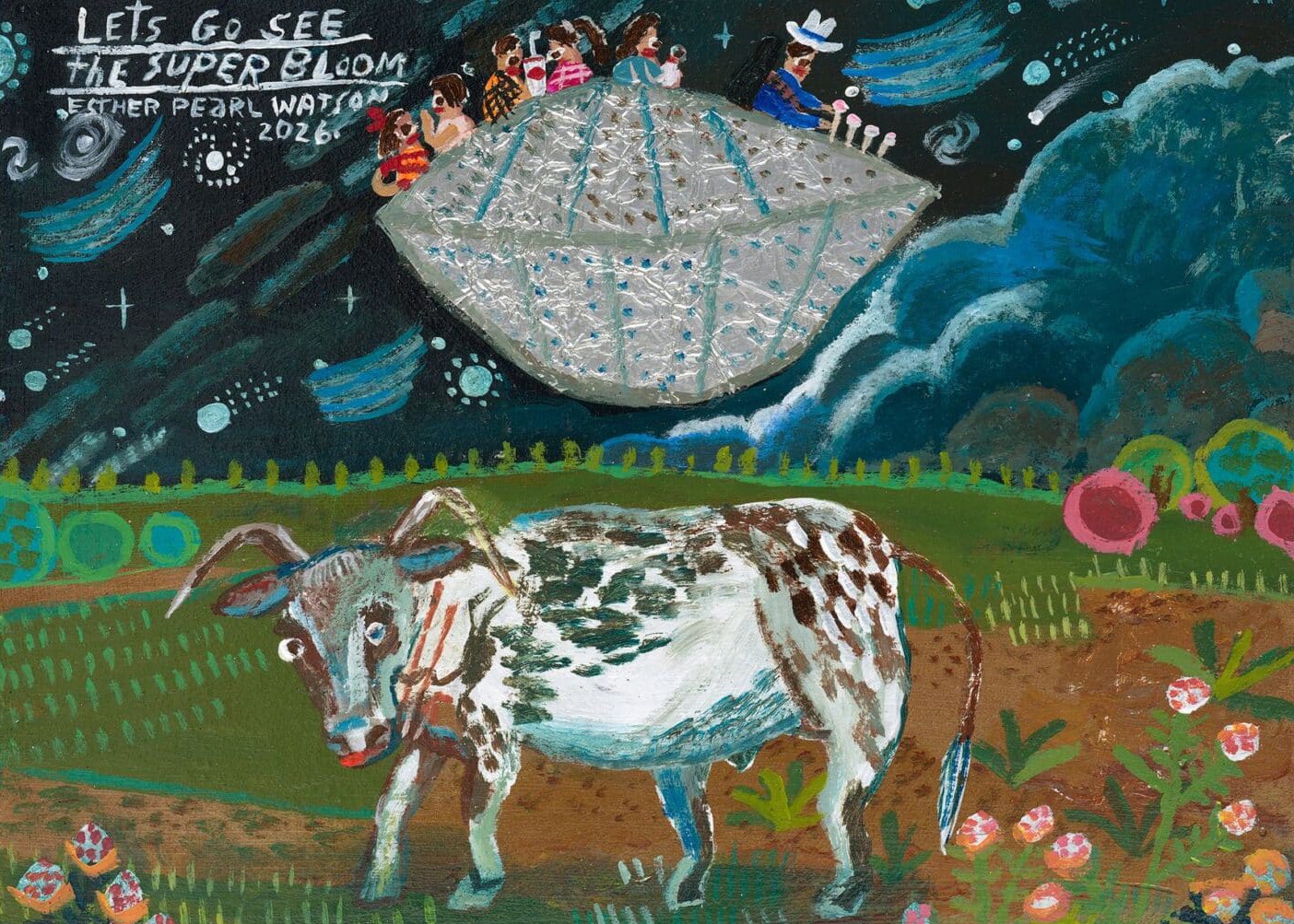
Esther Pearl Watson’s show at Vielmetter is the kind of show you would like if you were on a lot of mushrooms and lived in the middle of the desert far away from people and hadn’t heard of standards or seen any art before.
Small paintings full of feel-good flowers and cows and Unidentified Flying Objects, painted with a “juvenile hand” sharing wall space with faceless characters and people with arms that squiggle and flop. One might look at this collection of small acrylic works and call them folksy-naive—the kind of art done by grandmothers in their 90s high up in the Appalachians or school children at day camp. Only this time UFOs play central characters and at least one thing in each picture feels directly lifted from some more-distinctive forbear like Lynda Barry, Forrest Bess, or Eric Carle (of Very Hungry Caterpillar fame).
Naive or outsider art, as a style or movement, is not something I mind. I’d take a Basquiat if someone handed it to me. But, Esther Pearl Watson isn’t naive, she’s just lazy. This isn’t the best she can do because it isn’t the best anyone can do—the attempt to represent something is not dramatized, only the chore of filling a rectangle. With what? Anything a contemporary art audience will accept—plus UFOs.
Watson’s work might live nicely in a four-year-old’s bedroom. Paintings of faceless females sitting on horsies traipsing through flowers and underneath pink and purple clouded star spangled horizons, silly cows and chunky cars sit beneath occupied and decorative skies.
While the paintings are awful, the drawings, done in what seems to be pencil, aren’t quite as bad. Paring Watson down to dry media seems to force her into a finer line and decide on a composition rather than an accumulation.
Watson’s obsessions and motifs do not automatically require an inspid treatment. Artists like Maija Peeples-Bright, born in 1942 in Latvia and a founder of the SF funk movement, have made careers depicting animals, flowers and sunshine in a style that is simultaneously frolicsome and unique. But where Ms. Peeples-Bright succeeds by bringing humor, patterned mania, and a melted edge to counter sweet and childish tropes—Watson just offers an alternation of arbitrariness, mud-color and sparkles.
Wannabe outsider art painted by middle-aged white women with MFAs doesn’t automatically have to fail, but if it doesn’t want to, it does have to try. Watson claims that her art is based on growing up in poverty while her father built replicas of space ships on their front lawn. I have no reason not to believe her. I also can think of no reason I’d rather see these paintings than the actual ships. As is, Watson is doing no more than gesturing toward something interesting in ham-handed gloves.
Image: Courtesy Vielmetter Gallery