
How many prints did Rauschenberg have to make?
Turns out the answer is almost as many as he could imagine, if he had access to a print house willing to give him free reign forever. For the exhibition: Robert Rauschenberg at Gemini G.E.L.: Four Decades of Innovation and Collaboration the print studio opened up their vaults to providing insight into a prolific collaboration that began in 1967 and which produced not only many innovations in the field but a massive cache of prints (including Booster, a full size print of Rauschenberg’s x-rayed body) and over 200 editions.
The exhibition on view is only a partial look into the archive—and this reviewer is tempted to say that’s more than enough—but there are genuine stand-out pieces including Ape (1969), a three-color (although it looks all red) lithograph collage of photography, what looks like fabric, and some kind of dial or compass whose disparate images form together to read like a sort of darkly ambiguous rebus of the Kennedy assassination and Rookery Mounds – Steel Arbor (1979) another three-color (this one looks black and white) lithograph collage of images of posts, wires, concrete mound and a car grill to form a sort of sketch of post-Constructivist pictorial space reminiscent of David Hockney’s Polaroid compositions.
Depending on how you look at it, printmaking was either the worst or best medium to capture Raschenberg’s creative mania. While silkscreen and lithography allowed him to easily juxtapose and overlap disparate images from disparate sources to capture the sort of anarchic banality of everyday life, as Rauschenberg’s fame grew and his style became increasingly defined there was an increasing suspicion that all of this juxtaposing and overlapping was now aimed at capturing nothing other than the disposable income of collectors who’d missed out on his earliest and most productive years. Much like the late Salvador Dali prints that populate the Dali Museum in Paris or Nancy Spero’s late work (conceived and created entirely by her assistants) much of Rauschenberg’s print work seems to simply reiterate his motifs and hobby-horses in random combinations and colors.
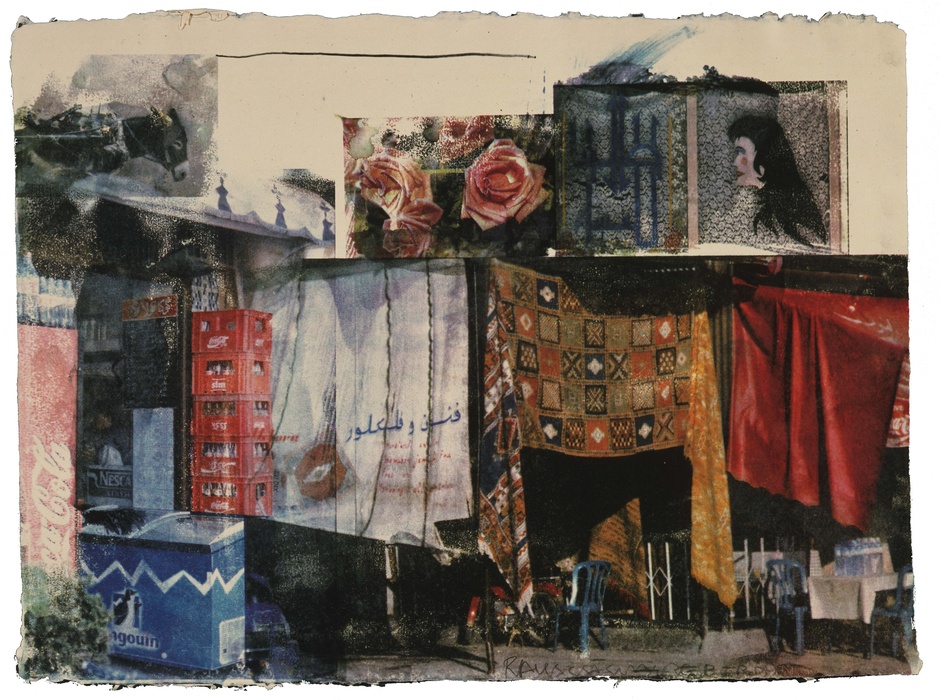
Rauschenberg’s prints on paper, on fabric, and any other material he can get to take ink are mostly multi-color versions of collages of people, words, flags, cars, mechanical parts, Americana, and symbolism that look like the kind of experimental works that art students make tons of—and that tend to fill up a dumpster behind the students’ studios at university. Maybe this was the point—Rauschenberg can be accused of having invented that style, or at least having popularized it, informed by European collage artists like Hannah Hoch and Kurt Schwitters. There was a reason early Pop Art was called—and sometimes derided as—“Neo-Dada”.
In printmaking, Rauschenberg seems to be at his best when he was at his most limited—when given anything over three colors or any other media (fabric, paper pulp, mud) to work with he seems to succumb to the stereotypical printmakers’ fascination with perfecting processes rather creating compelling images. There is genuine enthusiasm here but it isn’t for anything the audience can participate in. In addition to allowing Rauschenberg to put any picture or thing that would fit on a press next to any other, printmaking allowed him to reproduce the result by the thousands in wild and seemingly-uncurated variation.
And now Gemini G.E.L. is stuck with the dumpster.
Image: Courtesy Gemini G.E.L.