
by C. Montague
In these dim and downsizing days, where technocracy vies with idiocracy to see who can step on all of us faster, one keeps expecting the art produced in this spectacle’s shadow to show some sign of not just knowing but feeling how horrible it all is. Yet, month after month, even the scrappy young spaces seem to emit nothing more angsty than seen-it-all irony and allegories of middle-class-confusion. Where, one might ask, is the counterculture? The anomie? The democratic reaction?
Tip of the Berg’s inaugural exhibition—Cluster Hang—argues not only that it’s here, but that its been here all along. The space occupies a recently-converted section of artist-turned-gallerist John Mascaro’s custom canvas-and-frame business MUT LA. On display: Toilets, trash, streets, assemblage, creepy images and Gus van Sant. The grit and gutter that the mainstream of contemporary art—with its sophisticated attempts at flaneuristic faux-naiveté and post-minimal aesthetics—have to exorcise in order to present an ordered world its small jokes are capable of disrupting.
Legendary LA street photographer Estevan Oriol has several black-and-white photos of LA street culture and gang life in the show and one in color—showing an abdomen full of bullet hole scars. Royal Art Lodge veteran Jon Pylupchuk contributes a handbag-turned-creature sculpture and a small toilet with two inset fuchsia incandescent lightbulbs sat atop a wood crate on the floor, the very epitome of low-budget bathos.
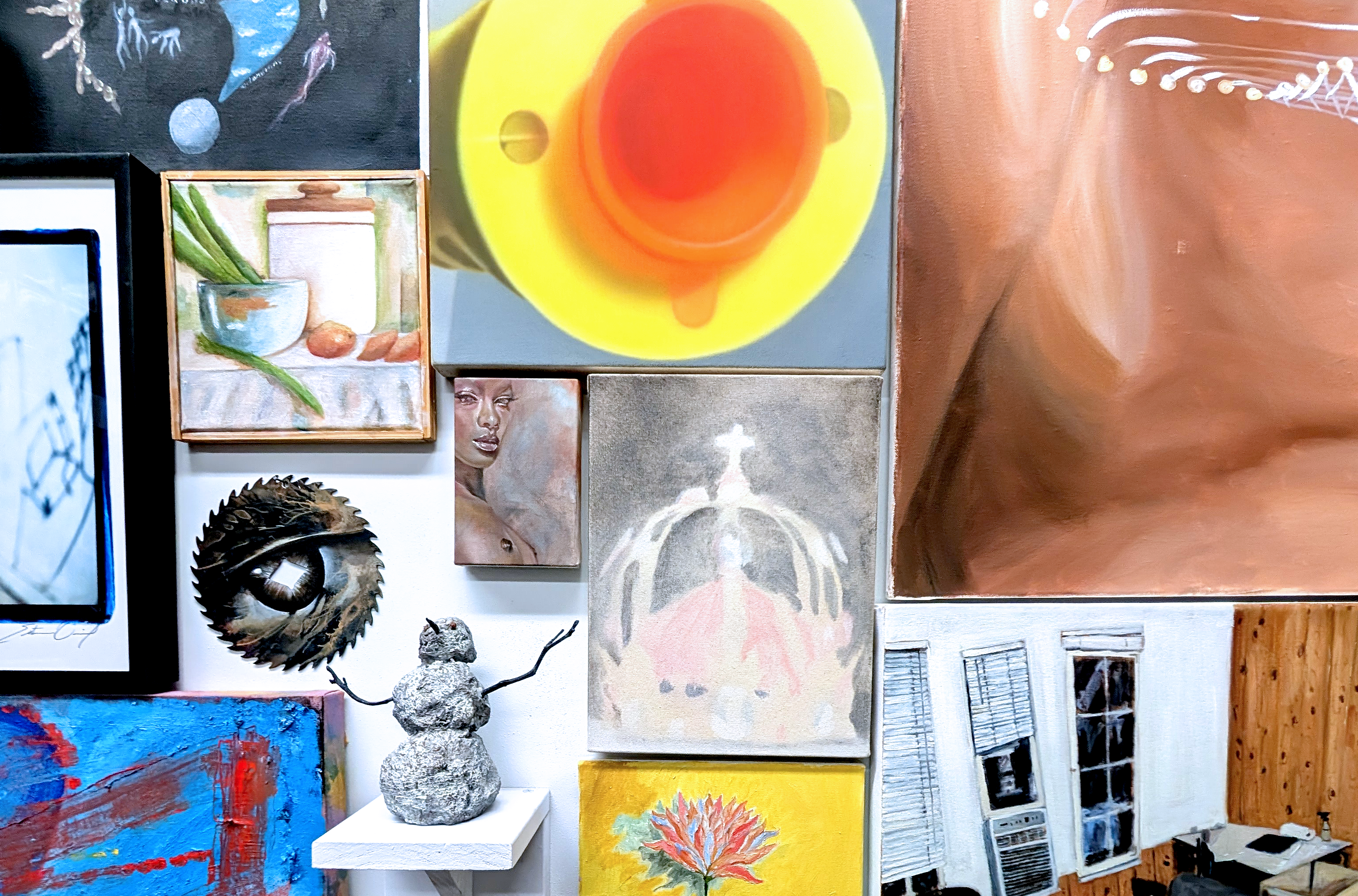
The rest, by emerging and mid-career artists, is mostly a combination of paintings and sculpture, with the majority of pieces smaller than 24 inches by 24 inches. Only a handful broke this convention—one of which was a large diptych of photo prints on canvas depicting a man about to stab himself in the sternum with a knife—the combination looked like the kind of living room wall mish-mosh inside of your favorite aunt’s Hollywood Hills home next to her bottle of prozac.
It is difficult to sort out, critically, whether this is a snapshot of the mixture of the old-and-neglected and new-but-failing is genuinely what life in the United States feels like right now, or whether it is a retrophilic attempt to root around in the ‘90s gangsta/grunge bargain bin for a language capable for meeting the current moment. Either way, it isn’t what we’re used to.
Image: Staff