
by R. Thorne
In our ever-shifting and uncertain cultural landscape, there is one fact that we know for sure: complaining about Yoko Ono does no good. You wouldn’t think you’d have to—pieces like “Painting to Hammer A Nail In” beg the viewer to consider what a Congolese Nkondo would look like if it were dull. Yoko’s music is so notoriously unlistenable that the albums without John Lennon on them are virtually the only hippie artifacts of comparable fame with less than a million views on YouTube. Yoko is the most powerful living argument for the fact that conceptual protest art—even when backed by all the money in the world, like 2007’s Imagine Peace Tower—doesn’t work, and, yes, Yoko may have broken up The Beatles. Yet, she can reasonably claim, like the Ancient Mariner, “The many men, so beautiful!/And they all dead did lie:/And a thousand thousand slimy things/Lived on; and so did I.”
Yoko Ono is neither dead nor powerless. Here in 2026, as the waxing graph line tracing “people who don’t know why Yoko Ono is famous” begins to cross and eclipse the line indexing “people who quietly hate or at least roll their eyes at Yoko Ono” —interest in her work is likely at an all-time low. However, at 93, her name undeniably still wields enough power within the art world that if she has a role other than a smug icon of long-haired boomer impotence or a cassus belli for online feminists looking to complain about racism or misogyny (while maing no effort to listen to her albums or go near her artwork) then The Broad will find it. Yoko is in, Yoko will always be in, nothing anyone can do or say will ever make Yoko not in. The die was cast long ago.
From the press release:
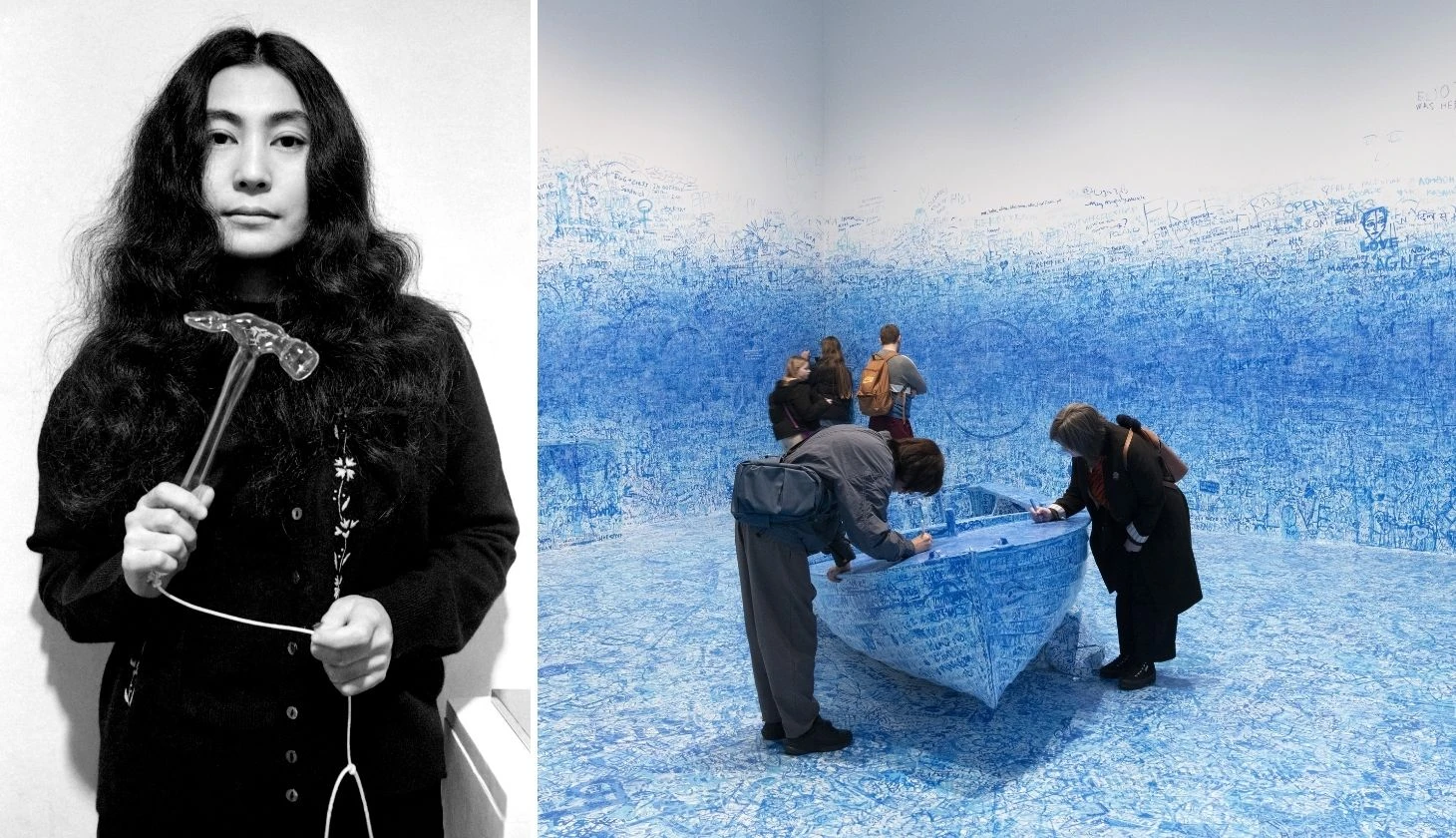
On view will be the typescript drafts for her famous 1964 book Grapefruit, which includes over 200 of these “instructions” arranged by types including music, painting, events, poetry, and objects: “Listen to the sound of the Earth turning,” “Fly,” “Put your shadows together until they become one,” and “Draw a map to get lost.” These works, which prompt audiences to think, imagine, and question, exist somewhere between score and poem.
The nicest thing you can say about this is “It was 1964”—if only everything here had that excuse.
Unlike poor Yoko, The Broad itself may still be worth complaining about. In over a decade of operation, this frozen-in-amber record of everything considered large, blue chip and inoffensive before Barack Obama was elected has done less to broaden or deepen public taste than any institution of comparable prominence. The first-time visitor’s dutiful turn through the permanent collection is so predictable you can time it with a stopwatch: once up the escalator, visitors note the familiar names at a breakneck pace, pause briefly, mercifully, to admire the Basquiat room, turn a corner, note Robert Therrien’s giant table and all its resemblance to similar attractions at Universal Studios, maybe look in at Jenny Saville, and speed out the other side, amazed the work is so unsurprising, the line outside is so long, and there are so few floors. It is the best advertisement for the Getty Museum yet devised.
The rotating shows have been no better than a succession of planted flags: Joseph Beuys—a sea of brown paper, William Kentridge—the least experimental of experimental animation, Takashi Murakami—busywork at best for his more talented interns. The closest thing to interesting they’ve done is show Mickalene Thomas just before she was cancelled.
We are genuinely not used to this—a huge institution in a distinctive building in the center of a world city containing, at any given time, no more than three pieces of any genuine interest, and seemingly no ambition to do any better. This is worse than The Beatles breaking up—its as if they stayed together and spent all their time trying to make sure nobody made music ever again.
Image: Courtesy The Broad Museum