
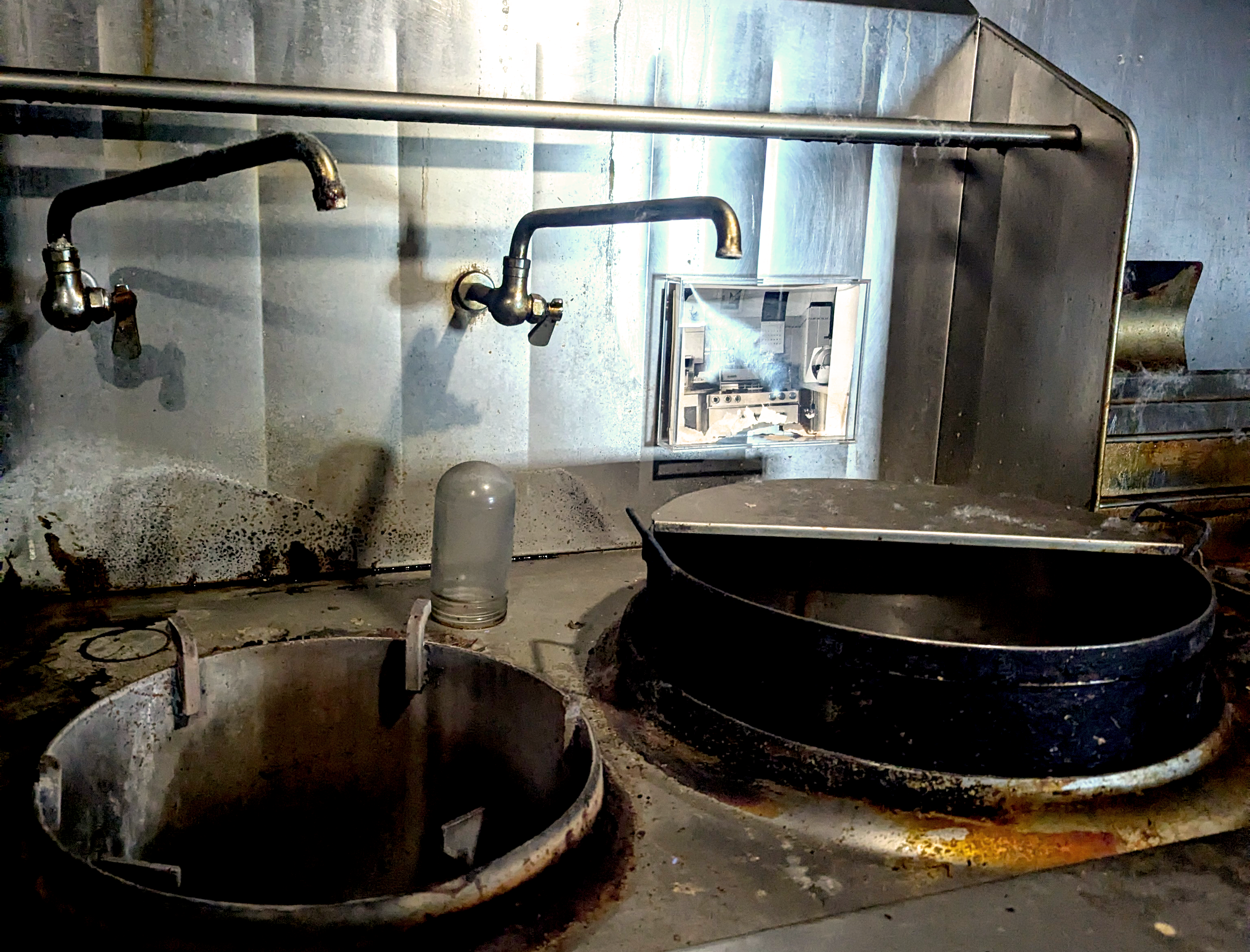
EDITOR’s NOTE: In the original version of this article, we misattributed some work by Joseph Klahr to Amanda Ross-Ho.
There are always art shows in odd spaces, a hallway, an alley, a bedroom, a convention center, but rarely when you walk into an exhibition space does it feel like you’re entering in the middle of an LA noir-horror film with a complete cast of characters, each you are sure has their own character story arc. This is how Leroy’s feels.
Leroy’s, a space which took over the Thanh Vi Restaurant, has turned the now defunct restaurant into a project space / art exhibition space located on the bottom level of 422 Ord Street, a building riddled with other small galleries including Fulcrum Press and Gene’s Dispensary, which sits at the corner of Ord and Broadway on the outskirts of Los Angeles’ Chinatown, an area beginning to see a resurgence no doubt in small (or large) part to Leroy’s. Bel Ami gallery is nearby and Charlie James along with NOON projects and MutMuz (a space operated by Devo’s Mark Mothersbaugh) are just up the street.
At Leroy’s, which shares its entrance with the somewhat underground parking garage, there is no white wall, instead you find tan linoleum-squared floors ringed with flower wallpapered walls weighted by 1970s era wood paneling rising from the floor and only half-way up the wall. This space is a relic to-, and a time capsule of-, 1970s Chinatown—when Roman Polanski, Jack Nicholson, and Faye Dunaway might well have been filming up the street.
The exhibition that I was able to catch encompassed paintings by Joseph Klahr and photographs by Amanda Ross-Ho. Klahr’s paintings included several of young children (squarely under 10 years old) in seemingly sad or lonesome circumstances—one lies alone in a bed wearing an oxygen mask while playing on their tablet, another sits alone bare-chested at a table eating from a soup bowl, another sleeps soundly in a nest of white bedding with a plush white bunny sat close by. These paintings are presented along Ross-Ho’s 1970s-style photographs tucked into strange spaces such as the back wall of the deep fryer area, in a light box on the a wall next to the sink area, and in a light box on the back wall of the stainless steep prep area.
The odd loneliness present in the photographs and paintings of children mimics the space in which they are shown, with much of the lighting being ambient from a glass fronted hostess case (which operates as a bar) near the entrance emitting a sickly yellow glow bathing the room with a dim hue of old cigarette smoke and tar. Task lights illuminate pieces placed around the space
The exhibition isn’t really about Klahr’s paintings or Ross-Ho’s photos, nor is it really about Leroy’s strange space and curatorial placement, but it is about how the parts combined to make something more interesting (and disturbing) then the individual bits alone. This is LA noir in art exhibition format and if David Lynch were still alive, I’d bet money that one would find him here, perhaps chatting in a corner during the galleries “occasionally open” hours.
Image: Staff