
Lately I have found myself craving human scale. The moment I wake up I am reading news of global threats, sitting in traffic that stretches to the horizon, hearing complaints pitched at entire ethncities, genders, political orientations, seeing paintings as large as the largest gallery they can be wheeled or craned into, installations made to dominate rooms, sculpture designed to compete with the views from millionaires’ windows. I want something that seems like it is made—not even for me, but just…just for a person somewhere. And why not? We are the only things that even have a word for “scale?”
Los Angeles is home to a gazillion vintage furniture purveyors, from pomo bookcases in shaped steel to refurbished modern couches to neon Liberace extravanagances to entire bars done in salvage-yard chic. Within this ecosystem are the few shops that import and or refinish mid-century modern Scandinavian furniture from Denmark—known for its smaller scale (the opposite of Texas big), sleek carpentry, spindly legs, and minimalist design.
A few days ago, I passed by a store front (I had never been in before) and noticed a small/large gathering of people looking at paintings on the wall amidst such furniture. I made a u-turn and stopped. It’s called Furniture Fosters. This is a stupid name, but the nice thing about being a furniture dealer is you don’t have to be good with words.
On the walls there were several dozen paintings of various styles and eras—most in earthy hues. Mid-century Danish painters were curated into salon-style arrangements alongside contemporary abstracts. Although these intimate, slightly enigmatic paintings, and the people who wanted to look at them, were the reason I stopped in, my attention quickly shifted to the furniture.
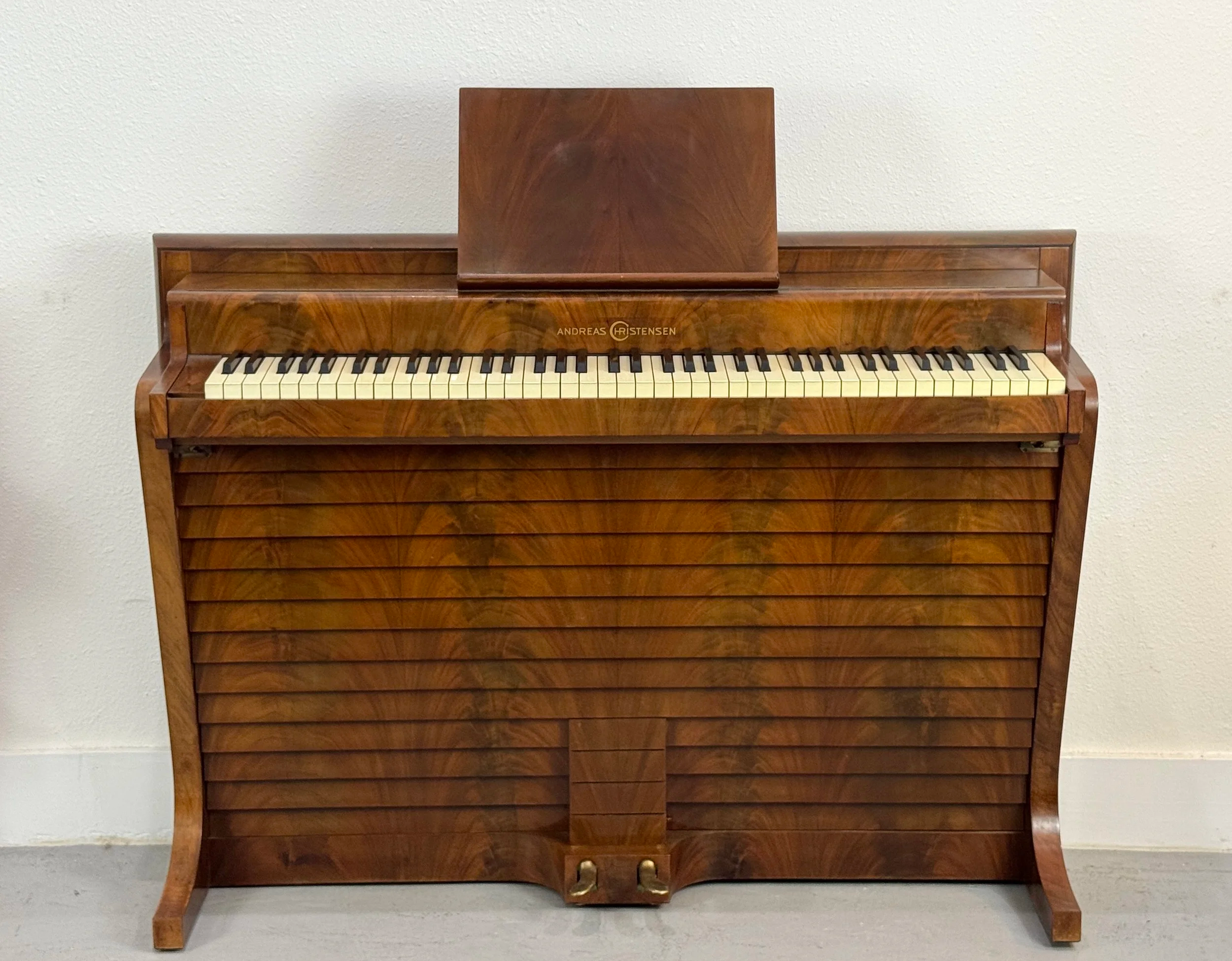
Small-ish pieces—a two-person love seat, a dining table for four, five or six, several pianos—all exquisitely made, and at a scale that American urbanites just aren’t used to anymore. Not a BarcaLounger on site, no wrap-around couch with inset drink holders. These were items from a time and place where a living room was not considered a thing that needed to be defeated, colonized, and then refortified with space-shaping mega-furnishings. This was stuff meant for something completely other than sitting in front of a television. These were made for the kind of space where a single candle could light the entire dining table and where people could whisper and still be heard. I sat on and at several of the pieces—wondering if the smaller scale would make me feel claustrophobic or want to punch the person next to me for invading my space. Here’s a 1950s loveseat from Sweden with a southwestern print and curved wooden arm rests. Was it perfect? Well, no. Wooden armrests are still, well wood even if expertly crafted—I do like an arm rest that can double as a pillow. But nevertheless there was a certain naturalness to it—as if someone somewhere cared.
The pianos, including a marbled wood piano by Danish design mainstay Poul Henningsen, were a far cry from baby grands. They are “single” person sized. In fact, two people were in the store playing two different pianos side by side—and both still wouldn’t have taken up as much floor space as your standard sectional. It was cute but also something better than cute—it was like a sign that things didn’t have to be the way we assume they always are. This was thoughtful, considered, warm. Human, and in a way that was generous to the next human. I think we all need more of that.
Image: Courtesy Furniture Fosters